China Ethnic Craft: Chinese Folk Toys
 As an indispensable part of traditional folk art, toys are a unique expression of the long and uninterrupted Chinese history. Religious beliefs, world view, taste, classical works and local customs, especially festivals and the 'Four Great Classical Chinese Literatures', are all represented by the use of various techniques requiring an artisans' deepest wisdom and creativity. The advantage is that the greater majority of people can enjoy the pleasure of toys that are easier to make and more widely available than other artistic works such as jade or silver wares, as they tend to utilize common articles that are readily available, such as cloth, grass, straw, clay, paper, and so on. Even so, it should be noted that these toys are not of a coarse manufacture, but of rustic simplicity and vivacity.
Generally, the diverse variety of folk toys can act as decorations to be appreciated or as knickknacks to be played with. As such, the two categories are those for festival decoration and those for daily enjoyment.
Festival Toys
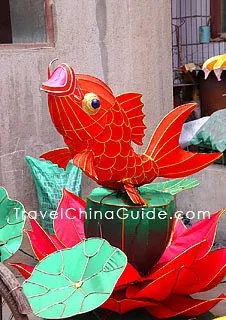
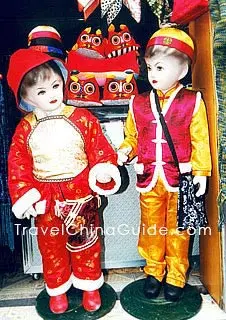 Toys during festivals are quite flowery and customary. In the Spring Festival, people use firecrackers and fireworks; in the Lantern Festival, there are lanterns in the shape of lotus, monkeys, dragons, etc; in the Pure Brightness kites will be flown in the blue sky; and during the Dragon Boat Festival, people will take sachet with them. Old people's sachet looks like a peach, symbolizing longevity while children's sachets are of lovely patterns, with fragrant herbs inside to ward off evil spirits. In ancient times, they were also a token of love that a girl would give to her beloved.
For Appreciation
Toys for appreciation and decoration stresses artistic conception. Carvings on root, stone and nut, painted eggshell, modeling with clay, porcelain and wax are all exquisite, especially those of figurines with their natural beauty.
Cloth paste pictures (collages) are interesting and distinctive. Most of its artisans are women who are good at needlecraft. Up until quite recently, almost every girl was able to make clothes and shoes out of cloth, with the off-cuts being used as convenient materials for collages. Choosing a large piece of cloth on which to sew or collage into the basic pattern, then adorn it with small pieces of lace. Utilizing color and texture and finished off with butterflies, tigers, children and real flowers are very appealing.
 The Hairy Monkey was probably invented in Beijing during the Qing Dynasty (1644-1911). By sticking many shaggy magnolia flower buds color resembles a monkey's fur, the lively posture of a monkey can be presented. As these materials are not readily available, this folk art is a lot rarer.
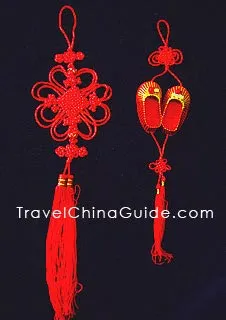
During the very early period of Chinese cultural development, the ancestors had worshiped the immortals. Rope, pronounced as 'Sheng', shared a similar pronunciation with the word for gods ('Shen' in Chinese), and when written, it looked like a dragon, an auspicious animal in Chinese culture; knots, in Chinese 'jie' means vigor, harmony, and unification, Therefore, this unique Chinese knots artwork has been a popular gift for thousands of years and embodies best wishes. People wore it in the beginning as a decorative addition to clothing, and later, used it to decorate their houses. Though the weaving techniques are complicated, ropes, in hands of a deft craftsman appear effortless moving the shuttle in between the rows of ropes. A Chinese knot is usually symmetrical in structure and colorful with jade or porcelain beads. This no doubt adds more jubilation to any festive atmosphere.
Euphonious Toys
Sounds can increase the amusement of toys. The main euphonious toys are whistles made of clay, porcelain, and bamboo. The simplest way is to blow directly along the edge of a leaf or blade of grass. Shadow puppets, displayed on the screen and steered by people behind, and the rattle-drum which can make the rattling sound by shaken are also favorites amongst children.
Play with Wisdom
 For Chinese who attach a great importance to the development of children's wisdom, jigsaw puzzle ('Qiqiaoban') might be the most ideal choice. Composed of 7 pieces in a certain shape, this toy requires one's brain exertion to join those pieces into a given pattern without leaving any gaps. The puzzle ring is another well-known game. It is said to originate from the Warring States Period (476–221 BC). Appearing to be one of the most incomprehensible games in the human history, it even aroused the attention of Western mathematicians. To separate the nine rings which are buckled together or to join separated nine rings together is quite intricate indeed.
Practical Toys
 Besides being for play, folk toys can also be of practical use, as part of finery, bedding and foodstuff. Children love animal-shaped pillows or hats. Today, the mascot of Olympic Games 2008 in Beijing is the lovely panda hat to numerous zealots. For the foodstuff, flour's plasticity helps people's imagination come true. In Shanxi Province, people are still experts at steaming flour figures. Suppose how pleasant they will be when seeing vivid edible flour rabbits and pigs!
Art and Craft in China: Jade
Jade has influenced all walks of life. In ancient times, people expressed abstract notions with concrete patterns of Chinese character, which were influenced by Taoism and Buddhism. Jade craftworks were among the most precious and luxurious ones; people wore and decorated rooms to indicate loyalty, elegance, beauty, and eternity. The most popular patterns were: peach (longevity), mandarin duck (love), deer (high official ranks), bat (blessing), fish (affluence), double phoenixes (thriving), bottle (safety), lotus (holiness), bamboo (lofty conduct), and fan (benevolence), etc.
In Chinese, jade is pronounced as 'Yu', and most words related to moral include this word such as 'Unpolished jade never shines,' indicating that one cannot be a useful person if he is not educated. Jade also implied honor and conviction. Many girls in ancient times were also named with jade to reflect the love of their parents. One of the Four Beauties in Chinese history, Yang Yuhuan, the beloved concubine of Emperor Xuanzong in the Tang Dynasty (618 - 907), was their representative. Yang is her surname and her given name Yuhuan means simply 'jade ring'.
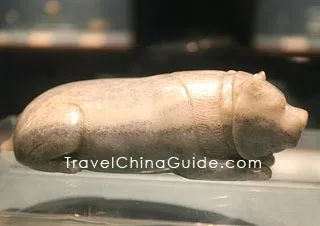 People believed that jade was the expression of the most beautiful stone. A beautiful piece can be more valuable than fifteen cities and a man's life. Historic records tell of a story about a stanch man named Bian He who had a piece of jade called 'Heshi Bi' which was said to be the most priceless treasure in history. However, when Bian He discovered the piece, it was hidden under the veil of the coarse stone in which it laid. He did not dare to carve it but instead dedicated it to the King of State Chu. He never knew that he would pay two legs for his dedication, for the king did not know the real value of the jade and cut Bian He's legs off. He cried for three days and nights. Afterwards, the new king heard of him and wanted to see whether his jade was as precious as he said. When the jade was cut, all were startled by the delicate quality. Very soon, it became a national treasure and was called 'Heshi Bi'. So precious was the stone that it even became a source of conflict between the Qin State and Zhao State.
 Jadeite
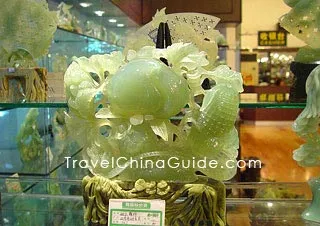 As early as the 16th century, Jadeite was believed to be a precious and hard jade with healing qualities for the human stomach and kidneys. Since it was brought into China during the early Qing Dynasty (1644 - 1911), it had been doted on greatly. Jadeite contains an iron component which appears red, chromium that appears green, and many other colored types. Known as the 'king of jade', it is usually a more expensive type of jade.
Nephrite Jade
Nephrite's robustness is due to the fact it contains tremolite. It also can be divided into several sub-classifications according to color: white, grey, green, topaz, and black jade.
In China, the most reputable jade producing area is Hetian in Xinjiang Province. Hetian jade is so hard that it can scratch glass. It has often been found in very huge pieces. An example of this is the huge jade hill on which the grand scene of Yu the Great leading people to control flood is elaborately carved. It was 5,350 kg weight (11,795 pounds) when it was completed. Now this artwork is displayed in the Forbidden City.
Serpentine jade, or Xiu yu in Chinese, is mainly from Xiuyan County in Liaoning Province. Made of many different ingredients, it takes on various appearances: white, yellow, light yellow, pink, green, dark green, light green and so on. This type of jade is usually coloured in various shades of green. Usually serpentine jade is semi-transparent or even opaque like wax.
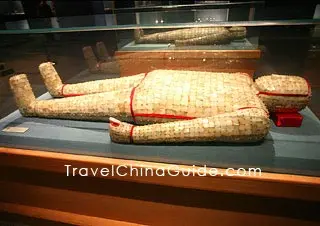 Lantian jade is produced in Lantian County, north of Xian in Shaanxi Province. It was also among the most charming ancient jades, for its rigidity made it easier to be carved into decorations and jewelry by our ancestors. The hue is uneven in colors of yellow or light green.
Nanyang County in Henan Province is famous for its abundant Nanyang jade. The ore district is located on an isolated 200 meter high hill, called Dushan Hill (thus its other name of 'Dushan jade'). It is distinctive for its whimsicality. Among the Nanyang jade artworks, you will find rare purple, blue and red ones.
Appreciation and Maintenance
Experts believe that, although more expensive, diamonds and gold cannot be compared with jade - jade is animated with a soul. They often buy to collect their favorite jade artworks, while people with little knowledge of jade may buy coarse works.
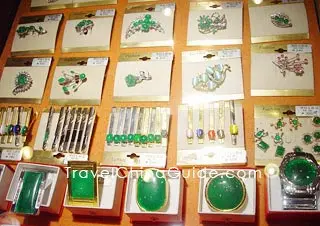 To obtain a real and choice jade article, you should take pains to learn and appreciate it. The criteria lie in the brightness of color and luster, compactness of inner structure, and the delicacy of the craftwork. For example, nephrite creates an oily luster and jadeite creates a vitreous luster. Tiny cracks can lower the value of jade; on real jade, air bubbles cannot be seen; the more lenitive the higher quality of jade, and so on.
Having purchased a jade article is just half the process of collecting. Jade is like a child that needs constant care. Enthusiasts need to work more to maintain this artwork, or blemishes may appear.
 First, avoid bumping on hard surfaces as jade is delicate. Although sometimes a crack cannot be seen by the naked eye, the interior structure may have been damaged. As time goes on, it will appear and reduce the value of the piece.
 Second, protect jade articles from dust or greasy dirt. If tainted, they must be scrubbed with a soft brush and light suds and washed with clean water.
 Third, when left unused it is best to store the jade in a case or box to protect it from being bumped.
 Fourth, jade should be kept away from perfume, perspiration or chemicals. The brightness of jade risks corrosion, especially emerald and other high quality jade, so it is better to clean it with a soft cloth after wearing it.
 Fifth, do not expose jade to sunlight for a long time, or it may expand and the quality will change slightly.
Finally, jade has certain water content so keep it in an area of humidity to protect it from over-drying.


