Showing posts with label Original Art of Indonesia. Show all posts
Showing posts with label Original Art of Indonesia. Show all posts
Reog Ponorogo and Warok
>
Reog ponorogo is an art that comes from ponorogo region, eastern Java. existence only emerged in religious ceremony and a celebration day. ponorogo identical with reog. reog beginnings were historically created by ki ageng kertabumi ticks to satirize the king, the king majapahit. are afraid and are subject to the concubines. There are also connecting origin connected with the story banner, the marriage between the sons of the kingdom and the daughter of kendiri Jenggala. so finally reog become a traditional art that still survive until today in ponorogo. even been extended to foreign countries.

reog development of this very day have also developed mainly in order to music and dance. kenong first example used only one thing but now wear two kenong. gamelan accompaniment even to survive. and thus named as reog style potrojayan style.

Warok ponorogo can not escape from reog ponorogo because that makes reog ponorogo former is warok. what you guys know what it warok? warok is someone who has much knowledge of psychotherapy. and reog can not escape from warok. both are closely related to each other. and to become a warok very heavy because the conditions were very heavy. and a warok must be able to give benefits to anyone.
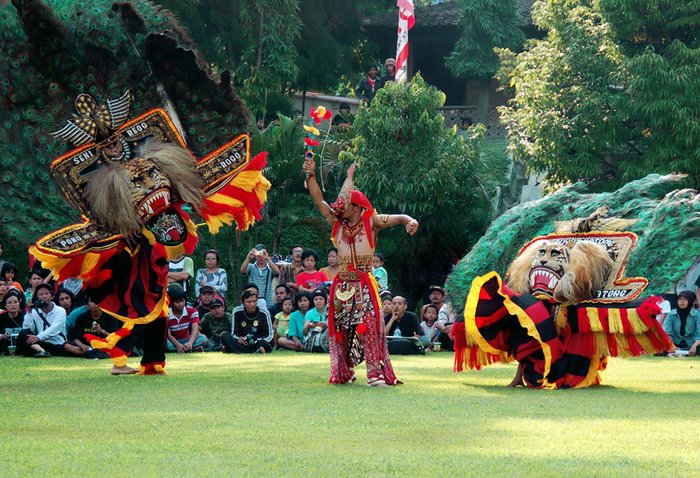
Reog usual festival is always visited by foreign tourists. and that surprised a lot more to make a record for the recalled memories because it was memorable. for people may see reog ponorogo usual but when the show actually begins nearly 80% reog ponorogo people streaming into the town square flock to see the annual event.
Batik Crafts
>
Batik is a cloth that traditionally uses a manual wax-resist dyeing technique. Javanese traditional batik, especially from Yogyakarta and Surakarta, has notable meanings rooted to the Javanese conceptualization of the universe. Traditional colours include indigo, dark brown, and white, which represent the three major Hindu Gods (Brahmā, Visnu, and Śiva). This is related to the fact that natural dyes are most commonly available in indigo and brown. Certain patterns can only be worn by nobility; traditionally, wider stripes or wavy lines of greater width indicated higher rank. Consequently, during Javanese ceremonies, one could determine the royal lineage of a person by the cloth he or she was wearing.

Other regions of Indonesia have their own unique patterns that normally take themes from everyday lives, incorporating patterns such as flowers, nature, animals, folklore or people. The colours of pesisir batik, from the coastal cities of northern Java, is especially vibrant, and it absorbs influence from the Javanese, Arab, Chinese and Dutch cultures. In the colonial times pesisir batik was a favourite of the derivative Chinese, Dutch and Eurasians.
UNESCO designated Indonesian batik as a Masterpiece of Oral and Intangible Heritage of Humanity on October 2, 2009. As part of the acknowledgment, UNESCO insisted that Indonesia preserve their heritage. Batik or fabrics with the traditional batik patterns are also found in several countries such as Malaysia, Japan, China, Azerbaijan, India, Sri Lanka, Egypt, Nigeria, Senegal, and Singapore. Malaysian batik often displays plants and flowers to avoid the interpretation of human and animal images as idolatry, in accordance with local Islamic doctrine.
Jump Stone (Fahombo) Nias Tradition
>Centuries ago, the island of Nias, located to the west of Sumatra, consisting of some the region governed by the landlord or warlords as high nobility, noble status was not a hereditary position, a position that they get with a party to entertain the public or owasa. So the more often they are a party, the more eternal and higher the position they are in the public eye, and cost the party a party they get from war booty.

To win the war noblemen would need the backing of powerful forces, so that at a certain time they open the opportunity for young men to become soldiers. For men become soldiers or members of the defense forces is an honor, with a better income from ordinary citizens and future opportunities to make their good fortune when a nobleman, achieved the glorious position as well.

In those days ago, the event was held in a special selection and lasted so festive, as if a festival, people flocked from far away though to watch the young men showed each skill to skip stones and trying to be the best. For the girls this event is an arena of worship and praise the men's dream and also vice versa, for men who pass the test quickly became the idol of girls. For those who already have a candidate, he immediately proposed to her choice, which still has a chance of getting Singles future wife. So fahombo finally shifted its meaning, as if implying anyone who managed to jump over the composition of such stones deserve to be called as an adult and married.
Fahombo now become a tourist attraction for the visitors of the island of Nias both foreign and domestic tourists and not only do young man, a frail old man even though allowed to jump.
Arts Debus From Banten
>
Debus is a martial art from Banten. This art was created in the 16th century, in the reign of Sultan Maulana Hasanuddin (1532-1570). Debus, an art which demonstrates the remarkable human ability, immune to sharp weapons, fire resistant, hard drinking water, insert objects into a whole coconut, fry an egg on the head and others.

Islamic religion was introduced by Sunan Gunung Jati, one of the founders of the Sultanate of Cirebon in 1520, in conjunction with the conquest expedition peacefulness of Sunda Kelapa. Then, when the power held by the Sultan of Banten Ageng Tirtayasa (1651-1682), Debus focused as a tool to evoke the spirit of the warriors in the fight against Dutch colonial traders joined in Vereenigde Oost Indische Compagnie (VOC).
It is said that martial arts originated from the area Debus al Madad. The longer the martial arts is growing and growing in all societies as the art of entertainment offerings for the community. The show is still very strong core martial arts or martial arts movement and use of weapons. Debus art offerings, many uses and focus on one player immune to attacks by sharp items, and sort of sharp weapon is called with the whistle.

Debus in Arabic which means sharp weapons made of iron, has a pointed tip and slightly rounded shape. With this tool whistle players injured, and usually can not be penetrated even whistle was beaten many times by others. Attractions attraction of this body immunity is another variation which is performed whistle. Among other things, belly pierced with sharp objects or spears, slicing the body with a machete until the injured and uninjured, eat fire, insert a long needle into the tongue, skin, cheeks until translucent and not injured. Cutting limbs to wounded and bleeding but can be cured in immediately, flush the body with hard water to clothes that cling dibadan crushed, chewed glass / glass flakes, burn the body. And many more attractions that they do.
In doing this attraction every player has a requirement that heavy conditions, before they perform the ritual ritual performances given by their teachers. Usually done 1-2 weeks before the ritual performed. In addition they are also required to have a strong faith and be confident with the teachings of Islam. Precepts for whistle players are not allowed to drink liquor, gambling, playing a woman, or steal. And the players also have to believe and did not hesitate in carrying out these actions, the offenses committed by a player can be very harmful to the player's soul.
According to some historical sources, Debus has a relationship with a congregation in Islamic teachings. Which in essence is very thick with religious philosophy, they are in very happy because face to face with his god. They slammed their ketubuh sharps, no effort but by God alone. If God does not allow a machete, machetes and bullets injure them. And they will not hurt.

At this time many warriors living dikecamatan Walantaka Debus, keragilan and areas of attack. Which is unfortunate existence of whistle more and more reduced, because the youth prefer to seek another livelihood. And because the attraction is also quite dangerous to do, because it is not uncommon that many whistle players hurt from lack of exercise and there are "ignorant" to show they are doing. So the longer the cultural heritage is increasingly extinct. In the past we can see the attraction of this whistle offerings in many areas, but now there are only whistle attractions at the event - a specific event. So not every day we can see this attraction. Cultural heritage, which is increasingly eroded by the changing times.
Wayang Kulit From Indonesia
>
Wayang kulit is a famous traditional form of puppetry in Indonesia, mainly in Java and Bali. ‘Wayang’ means ‘shadow’ in Javanese and ‘kulit’ means leather or skin. ‘Wayang’ has come to mean ‘puppet’ in Bahasa Indonesia, and is applied to the three forms of Javanese puppets: wayang kulit (shadow puppets), wayang klitik (flat wood puppets), and wayang golek (rod puppets).

The wayang kulit art form may be over 800 years old. The fact that the story is told using shadows is very important since moving shadows can be seen but never touched. One belief was that the souls of the ancestors were brought to life as shadows that provided advice and support. So wayang kulit performances have a spiritual and magical significance for Javanese and Balinese people. Everyone present at a shadow puppet performance is believed to be protected from evil influences while the play lasts. People will sponsor a performance to give thanks for someone recovering from illness.
The screen represents the white universe in which people live their lives. The bright side of the screen represents the material world in which we live. The darker side represents the mysterious after-life. The blencong or oil lamp was often in the shape of the Garuda bird, and represents the rays of the sun which give life to every living thing.
The puppets
The puppets are usually made from flattened buffalo hide with buffalo horn rods for support. The only moving parts are one or both arms, which may be hinged at the shoulder and elbow. The traditional cast of characters are intricately patterned and coloured. There are as many as 500 wayang kulit figures in an aristocratic set and as few as 100 in a village set. The manufacture of the puppets is very complicated and involves several different artisans.
Balinese puppets tend to be more realistic than those of Java. This may reflect religious differences between mainly Hindu Bali and mainly Muslim Java, as Islam forbids the depiction of the human form.

There may be several puppets for the one character. Depending on what the character is doing, the puppet will be shown with different clothing and with different colours to indicate its mood. Gold represents harmony, love of beauty and the finer things in life; dignity and calmness. Black represents more reflective, inward-looking characteristics, calmness and control; but sometimes anger and strength. Red represents physical strength, but a tempestuousness or fury. White represents flexible characters that are knowledgeable and full of life, as well as innocence, youth or purity.
Subscribe to:
Posts (Atom)


